

The runemaster steadies his hands.
The stone his customer has selected, a slab of granite, is tall and striking. Tiny specks glint in the morning sun: quartz, feldspar. The runemaster does not know these words. He knows nothing of the geological history or makeup of this stone, nor does he need to.
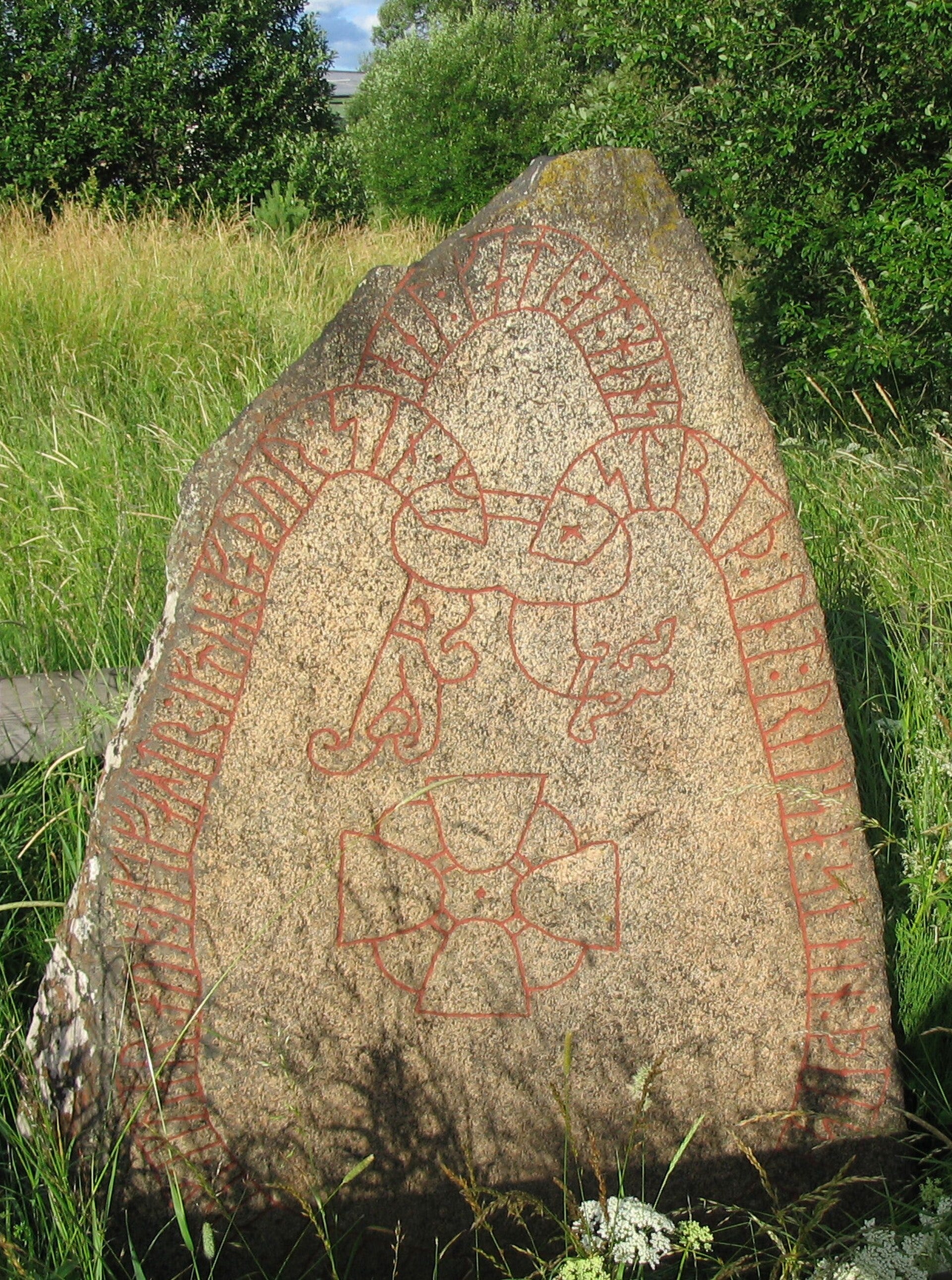
All that matters is that it will stand for centuries or longer, nearly impervious to the elements.
The year is 1000 AD. King Olof Skötkonung rules the Svear. The runemaster, here in the province of Uppland, knows little of these affairs, either. What he knows is the task in front of him. He raises his hammer and chisel.
Each strike rings through the village, surrounded by tall trees. The air is heavy with the mingling smells of woodsmoke, tanned hide, pine tar, and livestock. Chips of stone gather around the runemaster’s dusty boots as he works. He is careful, methodical. The hard material is unforgiving. A moment of carelessness can spoil his efforts.
Slowly, the shape of a wolf-like beast emerges. Then runic letters appear, one by one, scrolling ornately along a serpentine border that frames the wide gray surface. It is an ancient Germanic alphabet, dating to about 150 AD. “Rune” means “secret” or “mystery.”
The runemaster pauses, mops his brow, and continues. At last, the final hammer blow is struck.
The craftsman regards his handiwork, nods, then dips a brush in a bowl of red ochre. He meticulously fills the fresh grooves with pigment and watches the inscription spring to life in vivid crimson.
The runes declare that a man resided here. His name was Ulfr. This stone monument is being erected by his family in honor of a life well-lived, a life worth remembering.
A thousand years after they are gone, after the runemaster himself is no longer a memory … the runestone will stand.
A Public Message
The tradition of raising runestones began in the 4th century. Some of the early examples are associated with graves, though many were erected in commonly traveled areas: near the intersections of roads, at bridges and gathering places, and outside churches.
Most surviving runestones date to the Viking Age (about 800 to 1050 AD). While their purpose varied — some marked the borders of territories, others proclaimed inheritances — most were raised by families to memorialize the dead.
Among the most well-known are the Jelling stones, named for the town of Jelling, Denmark. Gorm the Old, who ruled Denmark from 936 until his death in about 958, raised the first of these in honor of his wife, the Viking queen Thyra. Their son, King Harald Bluetooth, raised a larger runestone to celebrate his parents and his conquest of Denmark and Norway. The stone also references the conversion of Denmark from Norse paganism to Christianity and features Denmark’s earliest depiction of Jesus.
In 1997, entrepreneur Jim Kardach was browsing the book History of the Vikings by Gwyn Jones. He saw a photograph of Harald’s runestone and proposed “Bluetooth” as the code name of a short-range wireless technology he and others were working on. It was meant to be temporary … but the name stuck.
There are about 3,000 surviving runestones in Scandinavia; the majority are in Sweden. Most commemorate men who died locally, though some were raised in memory of those who never returned from voyages and expeditions.
Made to Outlast Us
The instincts that prompted the creation of the runestones remain with us today.
We commission engraved bricks outside hospitals, universities, and even theme parks. We erect memorials for wars and disasters. We dedicate parks and park benches, walking paths, gardens, and library rooms to loved ones.
And then there are tombstones and grave markers, which are a topic for another time.
So much of communication is ephemeral. As Shakespeare wrote, words are but wind. Today’s newspapers line tomorrow’s bird cages. Text messages, social media stories, and headlines are absorbed and almost instantly forgotten.
The Norse runestones will be here long after we are gone.
They preserve names, prayers, reputations, and family ties.
They remember.